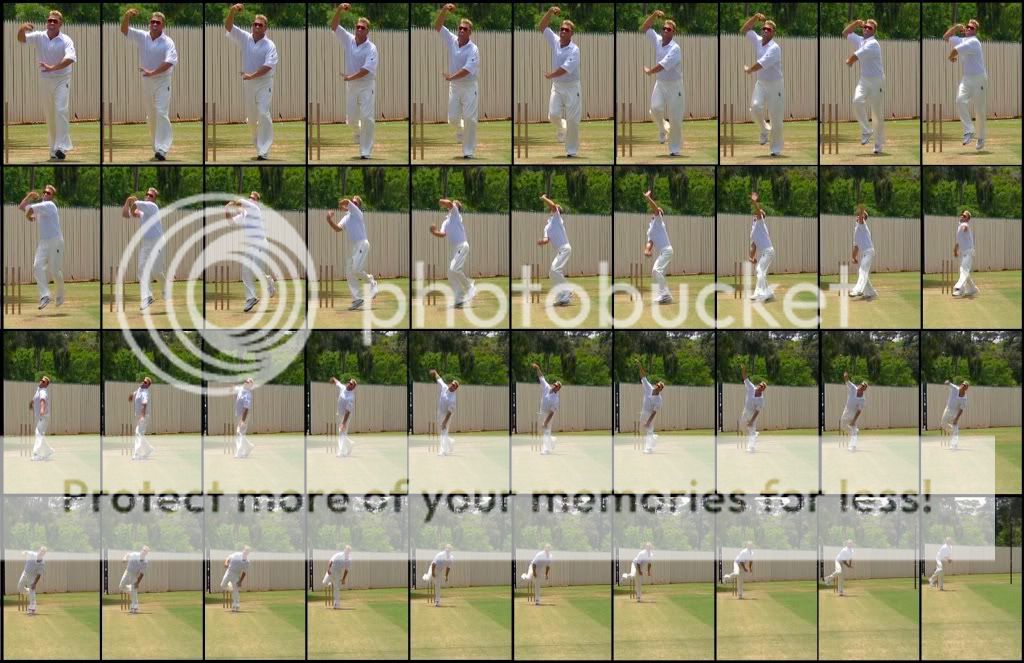
No-one ever showed me how to run-up to the crease and bowl,
I just worked out a way of doing it as a kid, so when I returned to cricket
much later in life, I just reverted to the way I did it at school. For the last
8 years or so I’ve worked on it a little with some guidance from people on the
internet and as a result modified it a bit, but I’ve always been aware that
it’s not that good and it's massively inconsistent changing in games and during the season and I’ve never been able to figure out how to go about improving it.
This year at the start of the season I bowled fairly successfully
off of a slightly longer run-up than usual. This happened after some feedback from a good
wicket keeper I played with for a month or so, and as a result I took a decent amount of
wickets. I then injured myself and went back to shorter run-ups for the rest of
the season while my Achilles tendon healed.
Towards the end of the season I
watched a SKY TV master-class featuring Glenn McGrath which has since been
removed. In this master-class, he explained how important the run-up is, but
went further in that he explained how he established his run-up and this
resonated with me, because I’ve never heard anyone explain how you might go
about establishing a run-up. This is basically what he said as far as I can recall and it’s pretty straight
forward...
Get
a mate to watch what you’re doing and mark out the specific finishing
points.
Find
a football pitch or somewhere with straight line on to run along.
With
a ball in your hand run along the line gathering speed or establishing a rhythm,
at this point don’t worry about starting and ending points, just run along
the line gathering pace until it feels right to go into the delivery
stride. Do this about 10 times or longer if required until it feels right.
Now
mark a starting point and repeat that run-up watched by your mate/coach.
Each time you stop, get him/her to mark your BFC (Back foot contact) point
– where you land coming out of the bound. Repeat this, 10 times to
establish your most consistent landing point.
Measure
that length out – that is your run-up, work with it and tweak it so that
you don’t over-step the crease.
Keep an eye out for the video as it may reappear someday.
In the meantime despite the fact that this is a seam bowlers run-up - the basic premise relating to setting off on the correct and consistent foot and maintaining a smooth approach is all relevant and worth having a look at, as to is Stuart MacGills video.
This Blog
takes a lot of work to produce and it's free to access, please help to keep it
alive by clicking on my adverts. Liking it on Facebook, Google +, sharing it on
Twitter and other social media. Also check out my videos here and
remember there's more content at
I came to wrist spinning out of nowhere in my late 40's and prior to that never played cricket and then worked on everything I do and know through a process of self reflection and watching videos and reading about it. One of the things that I've struggled with during this 8 year journey is my run-up and the approach to the crease and then as a consequence of those components the action through the crease. From posting videos of my bowling on Youtube I've had numerous people look at it and comment about it as well as team mates... You're to slow through the crease, you haven't got a bound amongst the observations.
With no or little coaching, and with the criticism there and the video evidence, it's difficult to come up with a coherent plan going forwards. It does seem that the obvious conclusion in a lot of people's minds as well as my own is to look for a template in someone else's bowling and this is discussed in the section below with regards its merits as a process to resolve the issue.
The issue I've had is that the bowling action that I use at different stages in the season changes in response to different issues. Sometimes I've been concerned that I bowl too slow, sometimes it's been a case that I bowl too fast and the spin is reduced. Other times it's been inconsistencies with line and length and in a reaction to each of these problems I've concluded that the main culprit has been my run-up and the approach to the crease. But a couple of months ago I watched a SKY TV master class with Glenn McGrath and during it at 16 minutes and 40 seconds he talks about something that I've never heard discussed before in such a simple way and it immediately resonated with me. He talks about and explains how he developed and worked out his run-up and it is so simple.
*Unfortunately some removed that video from Youtube * I'll write up an explanation at some point to make up for the loss of the video.
I've now in a week worked on this and gone from being generally confused and wondering whether I should bowl like a, b or c to now bowling my way.
If you have a look at my Youtube channel here you'll see some video's where I'm working with this new action. Furthermore I've come to some additional conclusions that relate to the run-in aspect of bowling. The McGrath video here should be looked at and considered in conjunction with Stuart MacGills advice in this video below...
The MacGill video differs massively from most of the video's you'll find on the web as they focus on the micro details that should only be addressed once some of the basics have been fully learned. MacGill instead focuses on the fundamentals such as your run-in and approach to the crease. Don't dismiss this aspect and think of it as being a superficial part of the whole process, because it needs to be addressed sooner rather than later, especially if you are struggling with your bowling. Think of it this way. Your run-in and movement through the crease (Bowling action) is the rock bed or foundation of everything else that follows. If you've not got this part consistent and correct, everything else is going to suffer, it will be like building onto a sketchy foundation and having to do remedial work all the time as a result.
Repeatable and consistent action update and analysis.
Lovely day here in the UK, we're just a few days short of November when you'd expect to see frost, even snow some years and generally miserable cold and wet rainy weather, but as it's an El Nino year, so everything is a little weird. It's usually the case that summer lingers as it has today and then suddenly around about November 5th it changes dramatically and the wind shifts from the south to the East and we get unusually good snow.
A couple of days ago both son Joe and Ben joined me over at the home of cricket - Mopsies Park and we had a bat and a bowl, but it was a little damp. So I kept an eye on the weather looking for a better day and that was today. 27th Oct and we had bright sunshine, southerly winds and temperature of about 20 degrees centigrade... Warm!
Today it was Joe and I and we both had a bit of a bat and a bowl. Joe didn't bowl that well as he'd hurt his leading arm shoulder today. But I'd gone with the intention of looking at and trying a few things out. So, let's do this using the Gibbs Reflective Practice Model... What happened? We went over to Mopsies Park and used the all weather wicket and had a bowl. I was looking to see how accurate I could bowl, if I could increase my speed a bit and look at getting up on the toes and bring the leg through. I bowled in excess of 250 balls over a 2 hour stint.
Feelings? Physically - knackered now 6 hours later and was beginning to feel a bit knackered towards the last 50 balls. But, that aside there were some promising things to make note of and consider going forwards. There were some periods where the bowling was going a little haywire, I did at one point bowl 5 balls one after another wide down the legside. But I was able to get things back on track and soon after was bowling decently with a lot of the ball drifting as far as I could make out which is pretty unheard of for me!
Evaluation. (Good and Bad). I've come away with a range of feelings about how this went and since last night when I originally started this post I've looked at the video footage. Yesterday when I videoed my bowling and batting I had two cameras when bowling - one shooting the batsman's perspective which is something I often do and the other shooting from the side at the bowlers end. It's this perspective that is more interesting and looking at it I can gain a few positives and some negatives...
Good first; overall I'm quite pleased with the development and the basic idea of acquiring a consistent and repeatable action. This I think I've improved massively and looking at the footage each delivery looks pretty much identical. I'd been working on the gather aspect and this too has massively improved along with the leading arm. Bad stuff; It just looks slow and lacking in dynamism and looking at the way my 'landing foot' lands it looks as though it's not square enough to the wicket and I'm therefore not getting my body set-up enough to get side on and therefore the hip rotation is weak.
Anlaysis (Everything relates to bowling right arm wrist spin). This potentially opens up a new avenue of thought on my bowling action, but at the same time I'm running out of time because the UK winter is all but days away and the chances of their being warm dry weather in the next couple of days is diminishing. Looking at the video here, which is the side on shot with all the revealing information...
I can break down my bowling action into sections and start to analyse it and make sense of it.
The Gather; This was an issue some months ago and sometimes in the confusion of worrying about the run-up and what I was going to do at the crease, I'd find that my arms were flailing around all over the place. This was one of the first aspects of the new run-up that I looked at and in my research I found some basic advice that said to get the leading arm (Left arm) hand up around you right ear at the start of the gather and make sure that you're looking over the outside of the left arm down the wicket at the batsman or whatever it is you choose to look at at this stage of the bowling action.
I'm happy with this and as far as I'm aware this now happens naturally and I don't have to worry about it at all and it sets me up to then reach out long and strong with the leading arm.
Leading Arm: If I was to be super critical I might say that because I've formed a fist in the leading arm component of the action, it might not be as dynamic as an open hand really stretching out and reaching? I'm too worried about that, but it might be something that I look at later on, but for the moment I'm not that bothered by the fist.
The Bound:The bound looks fine and does seem to be one aspect of the action that does look pretty dynamic. If you look around at some of the international spinners some of them have fairly weak looking bounds, some looking like shuffles. It may be the case though that my bound needs to be tweaked slightly in order that I get set up to land more side on?
Landing out of the bound (getting side on).You can see here below as the foot lands it's not exactly at 90 degrees to the wicket and I feel that this doesn't set me up fully to get 100% side-on, which I'm sure is pretty important if you're looking to put loads of action on the ball at release.
Delivery Stride: This is the other component of the action which I think is weak is the stride out of the bound. The general advice is that your stride is simply one that you're comfortable with.
Looking around at the pro's you can see mine is weak/short... Terry Jenner - big stride..
Shane Warne - Big Stride
Pravin Tambe - Massive Stride
Stuart MacGill - Big Stride.
Yasir Shah - Massive Stride.
All of the Delivery strides shown here are far longer than mine, which gives me food for thought, but then they're far younger than me and their speed approaching the crease and dynamism through the crease is that much better than mine quite obviously. But is it something I need to consider and explore? Part of me believes so, but it's something I may look into and consider trying and experimenting with.
Rotation:I was unsure of the rotation aspect of my bowling and looking at the video footage from the batsman's end it appeared that I was very front on, but looking at the side-on video, I can see that there's aspects of the rotation that are coming together okay. As identified, my foot out of the bound lands slightly skewed and not exactly at 90 degrees to the wicket.
As in the diagram there's some scope to get that landing foot exactly 90 degrees, how significant this is I'm not 100% certain but everyone advocates getting that foot correct as it lines up the shoulders, hips so that you're side on and ready to rotate. Looking at some of my previous videos I can see that coming out of the bound and landing side on is reasonable...
Landing out of the bound - looking over the shoulder down the wicket, almost with my foot at 90 degrees. Hips and shoulders almost in line with the wicket. But, if you watch the video footage, the rotation is then somewhat thwarted? Looking at the videos here.. https://www.youtube.com/watch?v=JT1HhHntF2o - Shane Warne at the end of his career in the IPL, his rotation is very evident and in some cases he over-rotates to some extent. Terry Jenner in this video here...https://www.youtube.com/watch?v=HA7YC7SF71Q demonstrates a good 180 degree rotation. Both of the rotations seem to be a product of getting right up onto the toes of the braced pivot leg and the leading arm coming down strong. Jenner in his video talks about rotating 180 degrees so that your shoulder ends up pointing down towards the batsman.
Watching the IPL footage I noted with interest how short Warne's follow through is in a lot of instances, but at the same time how smooth. Another thing in the IPL footage is the position of his landing foot out of the bound, it's not always at 90 degrees.
Look at this video here which is very new of Warne bowling - watch the rotation of his hips as he bowls to Michael Clarke. https://www.youtube.com/watch?v=805j4dAPKUQ I also like the way he bustles in during his run-up something I don't seem to be able to do.
Leg action through the crease
This one is a tricky one with loads of different examples to look at that confuse you and contradict each other. Looking around the internet for examples one thing you shouldn't do is refer to finger spinners as this aspect of their bowling is a desired attribute for them. But for wrist-spinners despite the fact that you'll no doubt be able to find examples of it including Warne there is a definite sense within the Wrist Spinning community that what I'm about to discuss and advocate is the correct way.
First Warne and the incorrect way. Not for him obviously as it worked quite well, but for the rest of us this aspect of his bowling is something I'm increasingly being told not to do. Look at Funkster192's sequence here. At the bottom right-hand corner you'll see that at the end of his action his right leg swings out and round and you'll see many images of him doing this in stills images and video images. But this is not the best way to do it and it increases inaccuracy in your bowling.
But here below is Stuart MacGill who in so many ways was a better bowler than Warne and one aspect that is increasingly recognised as being better is his bowling action as a template to emulate. You'll easily see that MacGills leg doesn't swing out like Warne's - instead it pushes through. Watch the video...
At 2:57 Watch the bowling action of MacGill from the back and how his knee does not swing out and round described by one friend as the 'Dirty Dog Action' e.g. cocking your leg up. Instead MacGill's leg comes through like someone knee butting another person in the nuts. It pushes forwards and through.
I know looking at the footage of my own bowling that my leg swings out and round doing the 'Dirty dog' and this is something I need to address. As far as I'm aware and this is reinforced in MacGill's video, this leads to inaccuracy.
Another exponent of the knee through approach is Pravin Tambe, but watching this video the extent that it comes through and sometimes swings out a little differs which is interesting...
Follow through
Again in this session my follow-through was weak and this is something I need to look at and I suspect it's that overall lack of energy running and the lack of 'Explosive energy' through the crease.
Conclusion
So out of this one of the things that I thought may be worth looking at and exploring is the length of the run-up in order to get more speed and vigour into the whole bowling action. At the start of the season in 2014 I did really well with my bowling and that was partly down to the input of a bloke called Mike Blerkom who kept wicket for us for a few games. Normally he'd play in the 2nd XI rather than the 4th. But he made some useful observations about my bowling and one of them was around the issue of an erratic run-up. At the time I was caught between the notion of (a). A short step in like Terry Jenner, which was slow but produced more spin. Or (b). A much longer run-up - but a perception on my part that the ball spun less and if I got it wrong I'd go for runs and getting it wrong was likely to be more frequent, or (c). A compromise between the 2. Mike said - 'Use the faster run-in' and I did and it worked really well for a number of matches till I damaged my Achilles tendon.
So, today having seen this and realising that it kind of looks like the option (c) a compromise between the two methods, I'm now thinking how difficult would it be to add another 2 steps on to the run-up and look to get more dynamism and speed?
But - is it the case because of my age I'm never going to be able to produce the kind of explosive energy speed a younger bloke would be able to produce?
Action Plan Upload the video's and see if there's any advice on Bigcricket. Then in the meantime while I'm waiting for feedback I'll explore the idea of working with a slightly longer run-up.
I'll also look at trying to extend the delivery stride and video that. Finally just look at getting the leg through straight at the batsman and not cocked in the 'Dirty Dog' method.
2016 - With only a few weeks now till the start of the season here in the UK, I'm working on the new action increasingly trying to bed in the muscle memory aspect of the delivery. See the two videos below as I start to get it together prior to the first league game in the first week of May... Update and further analysis March 31st 2016 (Double click the image below).
Again more work April 7th 2016 - in this video there's a pretty detailed analysis of the rotation and getting side on in your action using slow motion sequences. A lot of people talk about rotating your hips and shoulders, this video looks at this and illustrates it. Double click the image for the video
Spin bowling bio-mechanics- bowling action basics and analysis Please note I'm not an expert - just an enthusiast (Work in progress 3rd Dec 2015)
Recently I came across a series of images that had been commissioned by one of the big cricket bodies to examine the break-down of the bowling action. I've been aware of the ECB's images that are readily available on the internet that illustrate the bowling action and they used the same terminology.
Phase 1: Pre Delivery Stride (PDS)
Phase 2: Mid bound (MB)
Phase 3: Back Foot Contact (BFC)
Phase 4: Front Foot Contact (FFC)
Phase 5: Ball Release (BR)
Phase 6: Follow Through (FT) Some what belatedly I realised the value of this method of breaking down the action and thinking of it in terms of developing my bowling action.
In 2015 (see other sections of this blog and my Youtube channel here ) I made the decision to completely re-configure my bowling action, looking to improve it. Looking around I found that there seems to be very little that is spin-bowling specific and that the majority of the advice and guidance deals with fast bowling. So this is my attempt as producing a series of illustrations and images that might be useful to the spin bowling community.
The bowling action whether it's fast or slow is pretty much the same thing and can be broken down into these different phases. Using this blog post you should be able to improve your bowling action.
Standing at the top of the crease - What are you doing and thinking? First, you need to know exactly where it is you're going to stand. I've heard people over the years say things like you shouldn't measure your run-up. Their reasoning being that if you're a good bowler, you should know exactly what you're doing and be able to get it right without measuring it out. I personally like that notion, but couldn't actually do it with any accuracy, so what I do is measure it out when we're playing at home before the other team are turn up. I have in the past used bowlers markers...
But always forget to retrieve them at the end of the game, so instead I now use the tops of Lucozade bottles and just press them into the ground as my marker.
Some people like to make a big gesture and scrape dirty great lines in the ground with the spikes of their cricket shoes. But whatever approach you take, obvious or discreet, it does need to be part of your approach and therefore needs to be consistent and repeated.
Stuart MacGill says that at this point you should be relaxed with your wrist nice and floppy and a loose grip on the ball. This is backed up by Warne in his tutorials on-line, he too advocates a loose grip, he equates a tight grip with having an overall sense of tension throughout the body and therefore unlikely to be relaxed. At this point make the decision as to what it is you're going to bowl, if necessary make field adjustments, Warne would suggest just make small adjustments but be obvious about it so that the batsman is focused on what you're doing, it may be the case that you may break his focus on his batting.
MacGill in his video emphasises the fact that you always set off on the same foot and that this process must be exactly the same each time... "Repetition, Repetition, Repetition". For me when I started to re-configure my bowling this was one of the key things that I changed right at the outset and it had a massive impact immediately.
Zubin Barucha in the Praveen Tambir video similarly advocates the need to have the exact same run-up each time, another point he makes with regards to the run-up is that your eyes should be level and your head not to one side (Something that Tambir used to do). As you run-in keep straight, don't zig-zag and keep your eyes along the same plane as much as you can both vertically and horizontally looking at where you're going to bowl. Barucha and Warne in videos both talk about the variation in the run-in being implemented by running in and arriving at different points on the crease. This means the delivery is executed for instance - close to the stumps or wide of the stumps, but when you do this, the way you run-in should be exactly the same, if you start slightly wider at your mark - do so discreetly.
The Run up ---------------------------------------------------------------------------------------------------- The run-up is important... very important and for years I've messed around with it and have never been able to establish a consistent way of doing it. I would suggest to anyone who bowls spin to take this aspect of what you do seriously. It may be that I was never coached, so never had this reinforced as being such an important aspect of what we do, but the bottom line is when you bowl you must be able use a...
Consistent and repeatable action Far too many of us look to Warne as a method of bowling, but I would look a lot further, look at Stuart MacGill, Pravin Tambe, Mushtaq Ahmed, Yasir Shah and Shahid Afridi examine and watch their bowling, watch their videos on Youtube, look at their run-ups and the way that they approach the crease. The Warne method is possibly one of the most difficult to emulate and use as a template because his physique and build is probably not like yours or mine.
But, more than anything you need to at some point synthesise the information you glean from watching the videos with something that suits your physique, lifestyle and age, it may mean like me, you will have to do some additional exercises working on core strength or your glutes, especially if like most of us you sit around all day working at a computer. (See this link here).
Have a look at this post here from my blog that looks specifically at developing a run-up.
Phase 1 - PDS (Pre delivery stride). ---------------------------------------------------------------------------------------------------------- For most of this, if you're going to analyse and deconstruct what you do you will need some form of camera and access to a computer with at least the standard windows software such as windows live movie maker. That will enable you to video yourself and easily edit the footage and slow it down in order that you can analyse what it is you're doing right and wrong.
PDS (Pre delivery stride). Sometimes referred to as the load up and the point at which you 'gather'. The key point in phase 1 for us as Wrist Spinners is that we set off into the bound setting ourselves so that we start to get 'Side-on'. It's essential that we get side on and avoid having a front-on or a mixed bowling action. My new run-up is short, some people have said that it is Mushtaq-esque I take three steps before going into the 2nd phase, I stand square on, without any angled run-in and start off on the left foot. The PDS gets me landing on my left foot, setting me up to get my body fully side-on through the bound (2nd Phase).
Front on view above you can see that I'm looking over my left shoulder in the gather, my shoulder have started to get into position whereby I'm side-on.
Again (above) you see that I'm looking down towards where the batsman would be - over my shoulder and outside of the leading arm in the gather. The wrist is cocked and through the run-in and the approach to this phase in the action, my head has been along the same plane not deviating from side to side - simply moving straight at the batsman - click the image to see slow mo footage of the action.
In the process of getting this right, one of the key pieces of information that helped me was the advice to get the leading arm hand up around my ear in the gather. Other key things you need to be doing at this stage is cocking the wrist, keeping your head up-right and your eyes focused on the target. This next piece of advice comes from a fast bowling tutorial but seems to make sense to me. Look at the two images below here and look at the position of the elbow.
If you click on the image there's a video that explains and illustrates the theory here. The image on the left is poor presentation of the elbow as it's hanging out wide, both the leading arm and the bowling arm should be compact at this stage as this aids accuracy, but having said that many of us bowl with a more round-arm action and it may be the case that this doesn't suit or work for you. Remember these are just ideas and each of these suggestions can be disregarded if they don't appear to work with you. For me this might make sense as I tend to bowl with more over-spin looking to be accurate.
Phase 2: MB (Mid bound) -------------------------------------------------------------------------------------------------------- This is the section where if you're a right arm bowler you'll have leapt off of your left foot and got airborne. It's while you're in the air that you'll then start to go from the chest on position to the side on position you'll need as you land out of the bound. It's therefore essential that you have enough 'Hang-time' in the air to get this side-on aspect. When you're learning this I found this is one of the sections that I had to really focus on in order to land out of the bound with my right foot landing side-on (BFC) Back foot contact.
When you're learning this or adapting this to improve your bowling think about how you land - your right foot needs to land side-on ready for the 3rd phase BFC - Back foot contact. It's while you're in the end getting ready for BFC that you start to get really side on which is required. It may take a lot of practice and concentration to get this phase working. It may also require that you go away and do some strength and agility work in order that you're able to execute and perform this part of the action?
My bound at this point has been commented on in that it may be a little high, some people reckon that it should be around about half the height of a set of stumps as a rough guideline, but I'm happy with mine and it may change over the coming months, but for the moment it feels good and it enable me to get side-on. If you struggle with the bound the advice is to use hurdles or some kind of object to jump over in order that it becomes more active and obvious. A coach that I've worked with and take notice of recommends that in the off-season when you can look at these issues, one of the ways that you can address them is to do things in an over-exaggerated way and then tidy things up in pre-season nets.
Phase 3: BFC (Back foot contact). ----------------------------------------------------------------------------------------------------------- BFC another phase where there's a lot going on including some of the really important aspects and if you're struggling with any of these aspects it may take some work to get these components working well. My feelings are if you break your bowling down into these phases, you can address them one at a time and bolt on the components as you go along. When I did this work to re-configure my bowling action and improve it, I did so using the phases starting with the run-up.
This to be truthful is an aspect of my bowling that I'm still working on, once you're at BFC, your leading arm needs to reach out long and strong (Beau Casson). Again going back to the video of Praveen Tambir here, Zubin Barucha makes a comment about the fact that Tambir gets more power into his bowling due to the fact that he manages to keep his elbow and the leading arm 'Up' longer than most people and in doing so creates something extra. As with a lot of these video's they don't explain these things in any real depth, this may mean the torque is increased or possibly the speed of the delivery? It's up to us as bowlers to implement such ideas and see if they work for us, but the differences may be relatively subtle dependent of whether the implementation of the arm coming down slightly later increases torque or speed. If it's torque, the impact may be more obvious? MacGill in his video again alludes to the importance of this, but describes it differently, but in doing so he's possibly emphasising the need to hang that leading arm up long and strong a little longer...
Click on the video.
The way he puts it is that he wants the leading arm in this section of the action stretched all the way down the side of the body, a full stretch and then the whole of that leading side of the body pulled down and straight through
The other important component of this section is the delivery stride and the length of it. Having shot footage of my bowling from the side I noticed this was a very weak aspect of my bowling and I then did some research looking into the bowling strides of the current and recent wrist spinners. The observations made were that their strides are generally big
Fully side on at this stage, we’re into the bowling action where we focus on the upper body, the arms now start to gain momentum, the leading arm reaches out
high and long, Beau Casson describes it as being ‘Long and Strong’, this
reaching out needs to be towards the batsman/off-stump and is described as the
‘Rudder’ – it dictates where you’re going to bowl the ball. As the leading (Left arm) straightens and
comes down towards the hip, the delivery arm comes up in unison,
but seemingly not
perpendicular to each other in the way that you might teach kids to bowl when
grasping the basics. There’s a crucial aspect to the timing here and the arms
can be out of sync with point at which you move into FFC (Front foot contact).
The movement from BFC to FFC involves the delivery stride
and this seemingly needs to be relatively long. If you
look at the current leg-spinners they all have long strides, so the inference
would be that this adds something, it may make the movement through the crease
more dynamic and add the necessary torque to get the ball spinning more. Most
of the advice discussing this part of the action talks about the energy levels
and making this part of the action ‘Explosive’, which makes sense as you’re
loading up to release the ball. But, it has to be comfortable, don’t look to
develop a massively long delivery stride in the way that Tambir does if it
feels wholly wrong and reduces the smoothness and rhythmic feel of the action.
Although having said that when practicing, consider and try using the over
exaggeration approach. I’ve always found that when I do things that feel
enormously exaggerated, on viewing them they’re never quite as dramatically
different as I imagined.
The big delivery stride then takes you to…
Phase * FFC (Front
foot contact).
As your front foot lands your foot should be pointing
towards **** Most of the advice says that the leg should be braced as you land
on the ball of your foot or heel and then go up onto the toes and pivot. There
may be some additional value in twisting the foot at the ankle at this stage to
accentuate to pivot. The back foot, led by the right knee, which is now coming
out of the BFC, drives through towards the batsman, NOT OUT AND AROUND, everything for the most part should be moving
forwards towards the batsman at this stage. Again, when practicing this out of
season, look to exaggerate this, one of the things I was told in the past was
to do this knee drive so exaggerated that the right foot actually touches your
butt, or at least you aim to do so as you drive the knee forwards. Look at Nathan Lyon for an example of how high
his knee lift component can be.
The other thing that is usually mentioned at this stage as
you get up on to your toes is to remain tall in the action.
The leading arm; This
come down straight from its long and strong position reaching for the batsman –
not swinging out wide and maintaining a compact aspect from the front, this arm
comes to fading stop at around the hip. (Check to see the ‘Tuck’ aspect – look
at what I do).
The bowling arm; The
hand/ball come out of the gather in an un-coiling action in an ever increasing
circular action, as the ball arm reaches about 11 to 12 o’clock the ball is released
with the wrist in whatever position in accordance with your delivery –
Leg-break, top-spinner, Flipper etc. The arm then comes down across the body
and generally your momentum will mean at this point having released the ball,
your body weight will topple forwards and the plane on which you head was
moving forwards on is lost as you start to now fade into
Phase FT (Follow
through).
The bowling arm will pass by your left hip and then continue
on swinging behind your back a little.
The rotation will mean you’ll be side on at the point just
after the fastest and most dynamic part of the action. You’ll be sideways, but
moving down the wicket, your legs in relation to your body will now have to
compensate for your side-on aspect as you slow down and finish the follow
through. Don’t pull up sharp, don’t look to jump into a catching position, be
alert to the fact that the ball may be coming back your way, fade out of the follow-through
smoothly again maintaining a straight line down the wicket being mindful not to
stray too near the middle, otherwise you’ll be penalised by the umpire for
doing so.
At all points throughout the action keep your head and eyes
just as a batsman does, along the same horizontal and vertical line.
Phase 4: Front Foot Contact (FFC) Phase 5: Ball Release (BR) Phase 6: Follow Through (FT)
Think of your bowling in terms of a structure- a building. You have to lay sound foundations on which to build something that is functional or better still special. If you don't lay the correct foundations you'll always be doing remedial work.
Okay it's fast bowling but the upper body - gather, leading arm etc all worth looking at.
This Blog
takes a lot of work to produce and it's free to access, please help to keep it
alive by clicking on my adverts. Liking it on Facebook, Google +, sharing it on
Twitter and other social media. Also check out my videos here and
remember there's more content at www.mpafirsteleven.blogspot.com